
On this page
- Downtown Alpharetta in brief
- How did downtown Alpharetta develop?
- What does that mean for gutters downtown?
- What is the best gutter setup for a house in Downtown Alpharetta?
- What size gutters does a Downtown Alpharetta home need?
- What gutter work is most common in Downtown Alpharetta?
- Should an older downtown house have half-round gutters?
- How do rain, trees and ground affect gutters in Downtown Alpharetta?
- What will a contractor look at on a Downtown Alpharetta house?
- What does gutter work cost in Downtown Alpharetta?
- When should gutters be cleaned in Downtown Alpharetta?
- Finding your way around Downtown Alpharetta
- Which gutter services are available in Downtown Alpharetta?
- Nearby areas
Downtown Alpharetta in brief
| City | Alpharetta, Fulton County |
| Chartered | December 11, 1858, after briefly being the town of Milton |
| Elevation | About 1,066 feet |
| Oldest buildings | Rucker Log House, 1833, and the Mansell House, 1912 |
| Typical housing | Early 1900s houses, 1950s cottages, new townhomes and condos |
| Common gutter | 5-inch K-style or 6-inch half-round on older homes; 6-inch K-style on townhomes |
How did downtown Alpharetta develop?
Alpharetta began as a trading post beside the New Prospect Camp Ground, a Methodist campground by a natural spring, and was chartered as Alpharetta on December 11, 1858. It was the seat of Milton County until 1931, when the county merged into Fulton to avoid bankruptcy during the Depression. The town stayed small for a century: 261 people in 1860 and only 3,128 in 1980.
The oldest surviving buildings include the Simeon and Jane Rucker Log House of 1833, listed on the National Register in 1997, and the 1912 Queen Anne style Mansell House, now home to the Alpharetta Historical Society. Around them, the blocks near Main Street and Milton Avenue have been rebuilt with townhomes, shops and apartments, and the 86-acre Avalon development opened in 2014 a short distance east.
What does that mean for gutters downtown?
Two very different jobs. On the older houses, the questions are about wood and style: rotten fascia, open eaves, and whether half-round or a slim K-style suits the house. On the new townhome rows, the questions are about volume and coordination: large shared roofs, tall three-storey walls, downspouts that must reach the street or a drain without crossing a neighbor's patio, and HOA color rules.
What is the best gutter setup for a house in Downtown Alpharetta?
| Part | Recommended for Downtown Alpharetta |
|---|---|
| Gutter | 5-inch K-style or 6-inch half-round on period homes; 6-inch K-style on townhomes |
| Metal | 0.032-inch aluminum; copper on some period homes |
| Downspouts | 2x3 or 3-inch round on older homes; 3x4 on townhomes |
| Hangers | Hidden hangers; brackets for half-round |
| Guards | Micro-mesh where mature trees overhang |
| Cleaning | Once or twice a year |
| Where water goes | Extensions or buried lines to the street; never onto a neighbor's patio |
| Main risks | Soft fascia on older homes; overflow on tall townhome roofs |
| Permit and approvals | Ask the City of Alpharetta whether a permit is needed for drainage changes; townhome HOAs approve colors |
What size gutters does a Downtown Alpharetta home need?
Older single-storey houses near Main Street usually manage with 5-inch K-style or 6-inch half-round, provided there are enough downspouts. Three-storey townhomes need 6-inch gutters and 3x4 downspouts, because the roofs are large and the water falls a long way. See 5-inch vs 6-inch gutters.
What gutter work is most common in Downtown Alpharetta?
| House type | Usual job |
|---|---|
| Early 1900s house near Main Street | Fascia repair and half-round or slim K-style |
| 1950s cottage or ranch | Replace original gutters, add drip edge |
| New townhome row | Add outlets, fix overflow at valleys, HOA-approved color |
| Shop or mixed-use building | Box gutters, scuppers, larger leaders |
Should an older downtown house have half-round gutters?
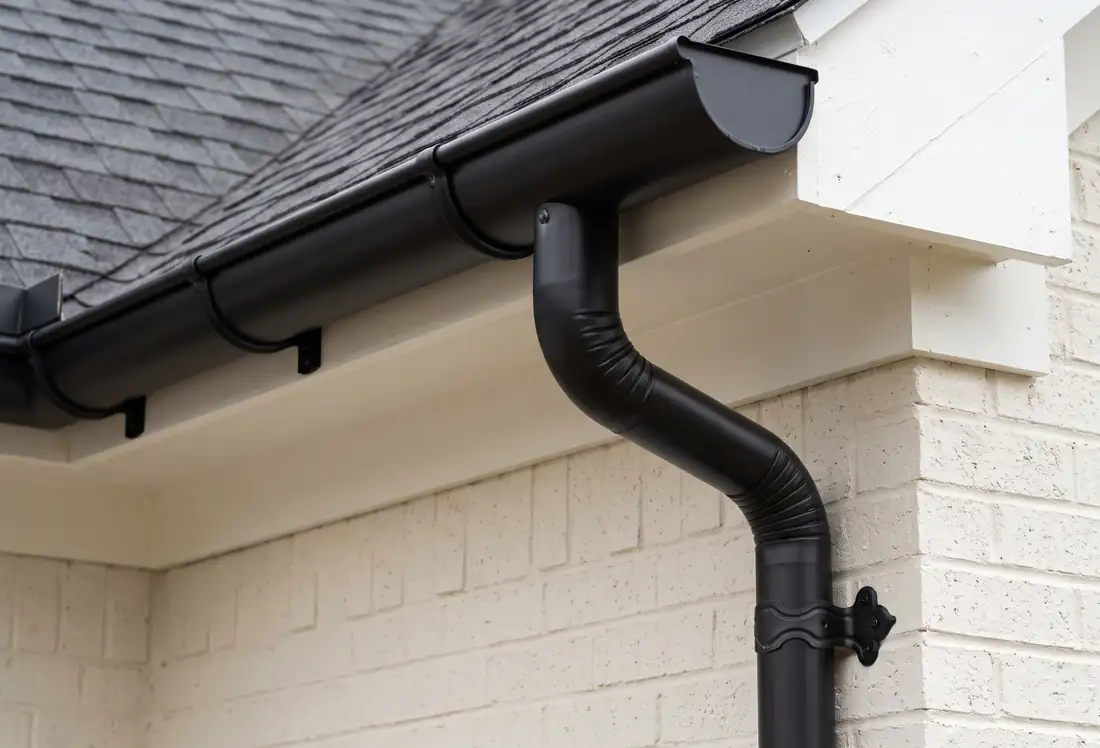
If the eaves are open with exposed rafter tails, or the house was built before K-style became common, half-round usually looks right. It hangs in brackets that can be fixed to the rafters, and copper or dark bronze aluminum both suit the period. Size it at 6 inches with 4-inch round downspouts so it can keep up with summer storms. See half-round gutters.
How do rain, trees and ground affect gutters in Downtown Alpharetta?
Downtown Alpharetta has no separate published rainfall record, but neighboring Alpharetta averages about 51 inches of precipitation a year with under an inch of snow, and much of the summer rain arrives in short, heavy thunderstorms. Those bursts, plus the occasional tropical system such as Helene in 2024, are what a gutter here has to be sized for. On older houses that has meant decades of summer storms on the same roof edges. Fascia and rafter tails behind long-leaking gutters are often soft, many older roofs were built without drip edge, and some downspouts still run into old clay or corrugated drains that silted up long ago. For gutters in Downtown Alpharetta, wood repair and a fresh look at drainage usually come first.
Trees are the other factor. Around Downtown Alpharetta the canopy is mostly oaks, maples and street trees, with some pines on older lots. Needles and leaves pack outlets, spring pollen turns to sludge in the trough, and a gutter full of wet debris holds water against the fascia long after a storm. That is why clogged outlets and soft fascia are among the most common problems contractors find here.
What will a contractor look at on a Downtown Alpharetta house?
On an older house the contractor starts with the wood. They probe the fascia and rafter tails, look for a drip edge or gutter apron, check whether the eaves are open or boxed, and run a hose into any old buried drain to see if it still flows. In Downtown Alpharetta that decides whether the job is a gutter swap or a gutter-and-carpentry job, and whether K-style or half-round looks right.
What does gutter work cost in Downtown Alpharetta?
Nobody publishes gutter prices for Downtown Alpharetta. National figures from Angi and This Old House put 5-inch seamless aluminum at roughly $9 to $14 per installed foot, 6-inch at $11 to $17, and copper at $29 to $40. On older houses, rotten wood is the unknown: it is priced per foot and only fully visible once the old gutter comes down. Ask for every item separately in writing.
When should gutters be cleaned in Downtown Alpharetta?
| Season | What lands in the gutter | What to do |
|---|---|---|
| Spring (March to May) | Pollen film, seed pods and flowers from street trees | A light rinse or check of outlets |
| Summer (June to August) | Roof grit and storm twigs | Look at outlets after big storms |
| Fall (September to November) | Leaves from yard and street trees, some needles | One thorough clean once leaves are down |
| Winter (December to February) | Little, apart from wind-blown debris | Good time for repairs on dry days |
Finding your way around Downtown Alpharetta
- Main roads: Main Street (GA 9), Milton Avenue, Old Milton Parkway, Haynes Bridge Road, Academy Street
- Creeks, rivers and lakes: Big Creek and the Big Creek Greenway to the east
- Landmarks: Alpharetta City Center, the Mansell House, the Rucker Log House, Avalon
- Neighbors: Windward to the north and east, Roswell to the south and west, Milton to the north, Johns Creek to the southeast
Which gutter services are available in Downtown Alpharetta?
Contractors reached through this site handle installation, repair, gutter guards, replacement, cleaning and commercial gutters in Downtown Alpharetta. Georgia treats gutters and downspouts as a traditional specialty trade, so ask for proof of insurance and any local business license rather than a state contractor number.
Nearby areas
Windward, Milton, Roswell, Johns Creek. Every town covered is listed on the service areas page.