
On this page
Where do gutters usually leak?
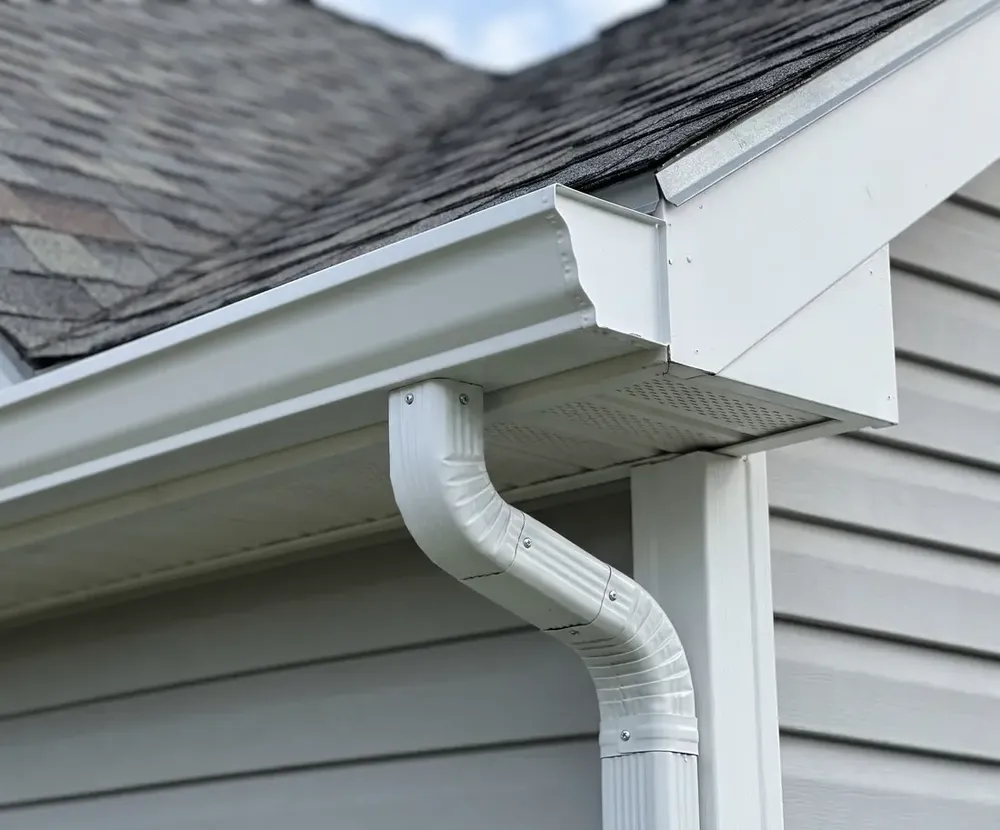
At joints. On a seamless gutter that means the corners (miters), the end caps and the outlets where downspouts drop out. On sectional gutters, every seam along the run is a candidate too. Holes in the metal itself are less common on aluminum and usually come from a limb, a ladder or rust on old steel.
| Where it drips | Likely cause | Fix |
|---|---|---|
| Inside or outside corner | Sealant cracked by heat and movement, rivets loose | Clean, re-rivet, reseal |
| End cap | Sealant failed or cap pushed out | Reseal or replace cap |
| Around the outlet | Seal around the drop failed | Reseal or fit a new outlet |
| Along a sectional seam | Joint sealant aged | Reseal, or replace with seamless |
| Behind the gutter onto the fascia | Water getting past a short drip edge | Add gutter apron |
| Through a hole in the trough | Limb strike, rust, old fastener hole | Patch or replace the section |
How is a leaking gutter joint repaired?
- Find the real leak. A hose run from above the joint shows exactly where water escapes. Stains below can be a few feet from the source.
- Clean the joint. Debris and grit come out and the old sealant is scraped and wire-brushed off.
- Dry the metal. Sealant needs dry, clean metal; damp joints are dried or the job waits.
- Tighten the joint. Loose rivets or screws are replaced so the metal does not flex.
- Apply gutter sealant. A bead goes inside the joint and is tooled into the seam.
- Let it cure. The sealant is left to cure for the time on the tube before water runs through.
- Re-test. Water is run again to confirm the leak has stopped.
Why do gutter joints leak in Alpharetta?
Summer heat. Aluminum gutters lengthen and shorten with every sunny afternoon. Over many summers that movement fatigues sealant and loosens rivets at corners.
Age. Much of Alpharetta was built in the 1980s and 1990s, as population climbed from 3,128 in 1980 to 34,854 in 2000. Many original gutters still have their first sealant.
Standing water. Gutters that do not fall toward their outlets hold water against the joints. A slight sag in the middle of a run is enough.
Debris. Pine straw and oak leaves hold water in the trough for days after rain, keeping joints wet.
Heavy storms. A clogged outlet in a summer downpour fills the gutter to the brim and pushes water through any weak seam.
Should I reseal or replace?
| Situation | Best option |
|---|---|
| One or two leaking joints on a sound seamless gutter | Reseal |
| Many joints leaking on an old sectional gutter | Replace with seamless |
| Leaks plus sagging and soft fascia | Replace gutter and fascia together |
| Leak through a rusted steel trough | Replace |
| Leak behind the gutter | Add gutter apron; check fascia |
What does leak repair cost?
Resealing is usually priced per joint or per visit rather than per foot. No published Alpharetta price exists. Ask the contractor to list which joints they will reseal and whether they will clean the gutter first.
Can I reseal a gutter myself?
On a single-storey house, many people do. Use a sealant made for gutters, clean off all old material and work on dry metal on a mild day. Do not just smear new sealant over old; it will not bond. Second-storey work and anything needing re-riveting is better left to a contractor.
How do I stop water running behind the gutter?
A gutter apron or properly placed drip edge closes the gap between the roof edge and the back of the gutter. Without it, water follows the underside of the shingles, runs down behind the trough and soaks the fascia. See fascia and soffit.
Leak repair terms
| Term | Plain meaning |
|---|---|
| Sealant | The flexible gutter sealant laid in every seam and around every outlet |
| Strip miter | A corner made by cutting two runs at an angle and bridging them with a riveted strip |
| Box miter | A factory corner piece both runs fit into, which leaves two seams instead of one |
| Hand-cut miter | A corner folded and cut from the gutter itself on site, riveted and sealed with a single seam |
| End cap | The plate that closes off the open end of a run |
| Outlet | The opening in the gutter floor with a short sleeve that feeds the downspout. Also called a drop |
| Drip edge | Bent metal trim along the roof edge, tucked under the bottom shingles, that steers runoff into the trough instead of onto the board |
| Gutter apron | A wider flashing that runs up under the shingles and hangs down inside the back of the gutter to close the gap |
| Fall | The pitch of a run toward its outlet, usually about a quarter inch for every ten feet |