
On this page
Why choose 6-inch gutters?
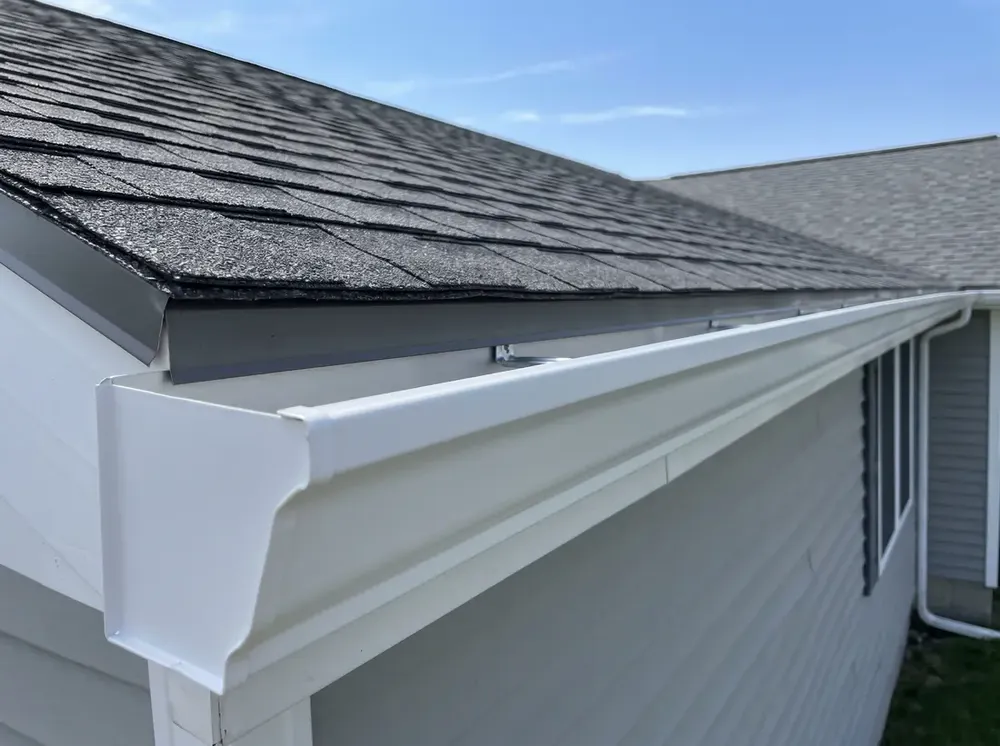
They carry a lot more water. A 6-inch K-style gutter holds roughly half again as much as a 5-inch one, and it usually takes 3x4-inch downspouts instead of 2x3, which drain far faster. On a large or steep roof, that is the difference between a gutter that keeps up with a cloudburst and one that sheets water over the front.
| Feature | 5-inch K-style | 6-inch K-style |
|---|---|---|
| Mouth width | About 5 inches | About 6 inches |
| Usual downspout | 2x3 inch | 3x4 inch |
| Capacity | Baseline | Roughly 40 to 50 percent more |
| Best for | Single-storey, modest roof planes | Two-storey, steep, large or valley roofs |
| Debris | Narrower outlets clog sooner | Wider outlets pass needles and leaves better |
| Look | Slimmer | Bolder line on tall walls |
When does a house need 6-inch gutters?
- Two-storey walls. Water from a tall roof plane arrives fast and in volume.
- Steep pitches. Steep roofs shed water quickly and can make it overshoot a narrow gutter.
- Valleys. Where two roof planes meet, they funnel water into one spot on the gutter.
- Long runs to one outlet. The farther water has to travel, the deeper it gets.
- Metal roofs. Water comes off smooth metal faster than off shingles.
- Heavy tree cover. Wider outlets and downspouts clog less.
How is a gutter upgraded to 6-inch?
- Check the fascia height. A 6-inch gutter is deeper; the fascia must be tall enough and the roof edge placed so water lands in the trough.
- Plan the outlets. Larger outlets for 3x4 downspouts, and extra outlets on long runs or below valleys.
- Remove the old system. The 5-inch gutters and 2x3 downspouts come down.
- Repair the wood. Any soft fascia is replaced.
- Form and hang the new runs. Seamless 6-inch is formed on site and hung on screw-in hangers.
- Add valley diverters. Where a valley dumps into the gutter, a diverter stops water shooting past.
- Run 3x4 downspouts. Each is led to an extension, splash block or buried line.
- Test with a hose. Flow is checked at every outlet.
Why are 6-inch gutters so common around Alpharetta?
Storm intensity. Alpharetta averages about 51 inches of precipitation a year, but much of the summer rain comes in short, heavy thunderstorms. That peak rate is what decides gutter size. When Hurricane Helene's rain hit metro Atlanta, Atlanta logged 11.12 inches in 48 hours.
House shape. A typical 1990s two-storey traditional in Alpharetta, Johns Creek or Milton has a large rear roof plane, a front gable or two and one or more valleys. Builders often fitted 5-inch gutters and 2x3 downspouts, which struggle on those roofs.
Pines. Wider outlets and 3x4 downspouts let pine needles pass instead of jamming.
Do 6-inch gutters cost much more?
A little. National guides from Angi and This Old House put 6-inch seamless aluminum at roughly $11 to $17 per installed foot, against about $9 to $14 for 5-inch. Those are national ranges. The bigger downspouts and any extra outlets add a little more. See the Alpharetta cost guide.
Will 6-inch gutters look too big?
On a single-storey ranch with a narrow fascia they can look heavy. On a two-storey house seen from the street, 6-inch usually reads as normal, and on tall rear walls nobody notices the difference. Matching the gutter color to the fascia makes either size blend in.
Can I just add downspouts instead?
Sometimes. If a 5-inch gutter only overflows at the far end of a long run, an extra outlet and downspout may solve it. If it overflows along most of its length in hard rain while clean, the trough itself is too small. See 5-inch vs 6-inch gutters.
Sizing terms
| Term | Plain meaning |
|---|---|
| K-style | The standard residential profile with a flat back and a curved, crown-molding front. Also sold as ogee |
| Outlet | The opening in the gutter floor with a short sleeve that feeds the downspout. Also called a drop |
| Downspout | The pipe that carries water from the outlet to the ground. Some people call it a leader |
| Valley diverter | A short metal fin set in the gutter where a roof valley empties, so the rush does not shoot past |
| Fascia | The vertical board across the rafter ends. Every hanger is screwed into it |
| Drip edge | Bent metal trim along the roof edge, tucked under the bottom shingles, that steers runoff into the trough instead of onto the board |
| Gauge | Metal thickness. Residential aluminum comes in 0.027 or 0.032 inch; copper is sold by weight, 16 or 20 ounce |
| Fall | The pitch of a run toward its outlet, usually about a quarter inch for every ten feet |